Key takeaways
- The 30% rule compares rent plus utilities to gross income, not take-home pay.
- It is the federal line for measuring housing strain, not a personal spending target.
- Check rent against your take-home budget, including debts, savings and move-in costs.
- Rent that fits on paper can still fail if it leaves no room for surprises.
Rent is usually the biggest bill you have, and it’s the one you can’t easily adjust once the lease is signed. That makes “how much rent can I afford” one of the most important money questions you’ll answer, and one of the easiest to get wrong under pressure while a landlord waits for your application.
The most common answer is the 30% rule. It’s a useful starting point, but it was never designed as a personal budget, and it can mislead in both directions. This guide explains where the rule comes from, how to run it, when it breaks, and a fuller check you can do in about fifteen minutes.
This is general education, not personal financial advice.
Where the 30% rule comes from
The 30 percent figure is the line the federal government uses to measure housing strain. HUD, the federal housing department, describes a household as cost burdened when monthly housing costs, including utilities, exceed 30 percent of monthly income, and severely cost burdened above 50 percent.1
That’s a measurement for researchers and policy: a way to count how many households are stretched. It became a rule of thumb for renters because it’s simple. But notice two things baked into the definition:
- It includes utilities. Rent alone is only part of the number.
- It uses gross income, before taxes and deductions.
It’s also a line many households are already over. The Harvard Joint Center for Housing Studies reported in 2026 that 22.7 million renter households, 49 percent of renters, spent more than 30 percent of their income on housing in 2024, including 12.1 million who paid more than half their income.2 If your rent is above 30 percent, you have plenty of company. The goal is to make sure the rest of your budget still works.
How to run the 30% rule
- Take your gross annual income (before taxes).
- Divide by 12 to get monthly gross.
- Multiply by 0.30.
- Subtract your expected utilities. What’s left is the rent the rule suggests.
| Gross income (example) | Monthly gross | 30% for housing | Less utilities (example) | Suggested rent |
|---|---|---|---|---|
| $40,000 | $3,333 | $1,000 | $150 | $850 |
| $60,000 | $5,000 | $1,500 | $175 | $1,325 |
| $85,000 | $7,083 | $2,125 | $200 | $1,925 |
This is the same test behind the landlord’s “earn three times the rent” requirement. Three times rent is roughly rent at a third of gross income.
Where the rule breaks
It uses gross pay, and you spend take-home pay
Taxes, retirement contributions and health insurance come out before your paycheck lands. Suppose, as an example, someone earning $60,000 takes home about $3,900 a month. The rule’s $1,500 for housing is about 38 percent of that take-home pay. That may be fine, or it may be tight, but it isn’t “30 percent” of the money you actually have.
It ignores what else you owe
Two people with the same salary can have very different room for rent. One has no debt. The other pays $450 a month on a car loan and $300 on student loans. The rule treats them the same.
It works badly at the edges
At lower incomes, 30 percent can leave too little for food, transport and everything else, even when the rent is fair for the area. At higher incomes, 30 percent can be far more than you need to spend, and following the rule “up” can crowd out saving.
It leaves out the cost of the place itself
A cheaper apartment farther away can cost more once you add a longer commute, parking or a second car. Renter’s insurance, laundry, pet rent and building fees also belong in the housing number.
A better check: start from your budget
Instead of asking “what’s 30 percent of my salary?”, ask “what rent leaves the rest of my month working?” Here’s a quick way to answer it.
- Start with take-home pay. What actually lands in your account each month. If you’re paid every two weeks, use the typical two-paycheck month.
- Subtract fixed bills other than housing. Phone, insurance, debt minimums, subscriptions, childcare, transport.
- Subtract realistic everyday needs. Groceries, gas or transit, basic household costs. Use what you actually spend, not an ideal.
- Subtract savings. Even a small, steady amount. If you skip this step, rent will quietly absorb it.
- What’s left is the most your housing can cost. Rent plus utilities, insurance and fees must fit inside it.
Here’s an example with take-home pay of $3,900:
| Monthly item (example) | Amount |
|---|---|
| Take-home pay | $3,900 |
| Car payment and insurance | −$420 |
| Phone, internet, subscriptions | −$140 |
| Student loan minimum | −$200 |
| Groceries and household | −$500 |
| Gas and transport | −$180 |
| Fun, eating out, personal | −$350 |
| Savings | −$300 |
| Room for housing | $1,810 |
| Less utilities and renter’s insurance | −$190 |
| Maximum rent | $1,620 |
In this example the budget-first check allows slightly more than the 30% rule’s $1,325. For someone with more debt, the same check might allow much less. Either way, you now know why a number works.
If you don’t know what you spend on groceries or transport, the last two or three months of statements will tell you. How to make a budget walks through sorting it.
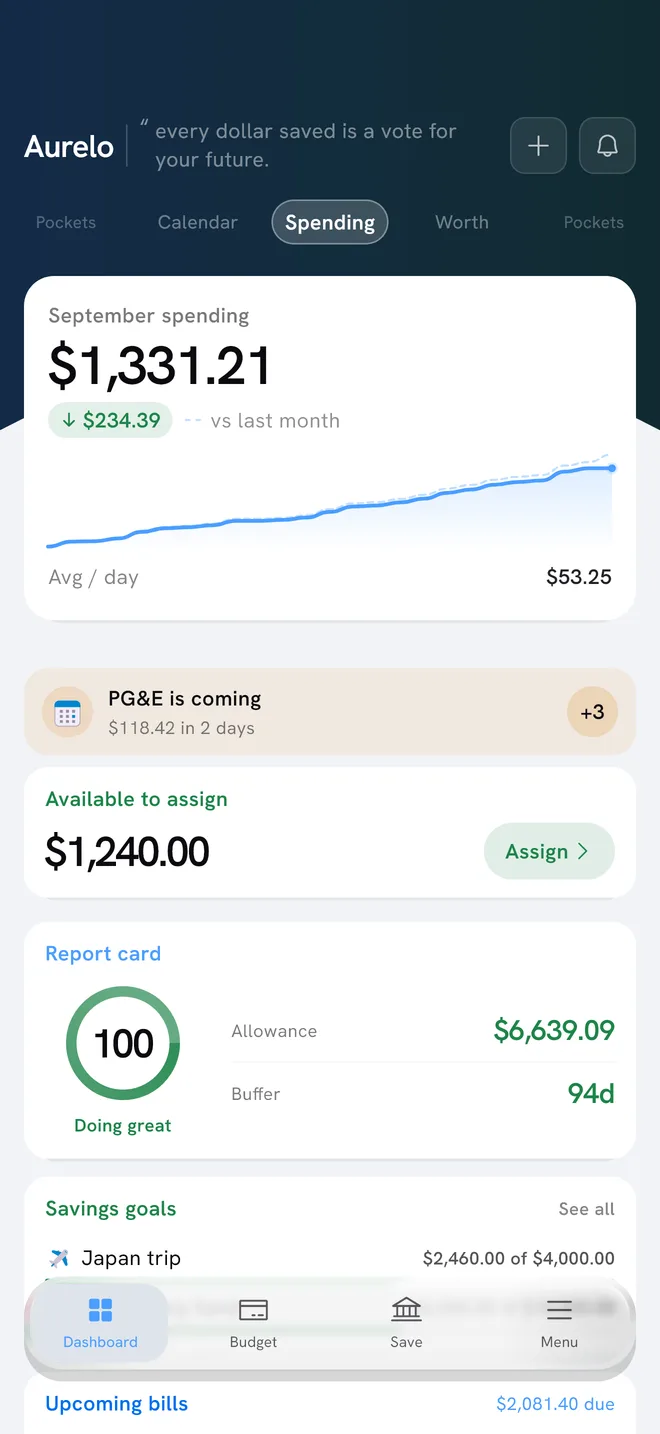
In Aurelo: Connect your checking account and cards, and Aurelo reads your last six months of transactions and suggests pockets that match how you actually spend. Put rent and utilities in your Bills pockets and you can see whether a new rent leaves your Needs and Wants intact before you sign.
Don’t forget the move-in costs
The monthly rent is only part of the decision. Moving often needs cash up front:
- Security deposit, sometimes plus first and last month’s rent
- Application fees and any broker fee
- Utility setup or deposits
- Movers or a truck, and basic furniture
- A cushion for the overlap month, when you may pay two rents
If paying these would empty your savings, the new place may be affordable month to month but risky to move into right now. Keeping a separate cushion, as covered in how big your emergency fund should be, means one surprise in the first month doesn’t turn into card debt.
Renting with a partner or housemates
Splitting rent changes the math, but the same check applies to each person. A few things to decide before signing:
- How to split. Evenly, by room size, or by income. Proportional splits can feel fairer when incomes differ a lot.
- Who pays the landlord. One person paying and others reimbursing is common, but it helps if everyone can see what’s been paid.
- What happens if someone leaves. Can the rest cover the rent alone for a month or two?
How to budget as a couple covers splitting approaches that don’t require merging every account.
In Aurelo: A budget can be shared with a partner or housemate. You invite them by their Aurelo account, and each person chooses which of their own accounts feed the shared budget. Accounts you don’t link stay private. Collaborating is free.
A quick gut check
Before you sign, ask yourself:
- Would this rent still work if my income dropped by 10 percent for a few months?
- After rent, am I still saving something every month?
- Could I cover a surprise $500 bill in the first month without a card?
- Have I counted utilities, insurance, parking and fees?
If you answer yes to all four, the rent is probably one you can live with, whatever percentage it works out to.
The short version
- The 30% rule compares rent plus utilities to gross income. It’s a starting point.
- Your real limit comes from take-home pay, after bills, needs, debts and savings.
- Count utilities, insurance, fees and commute costs as part of housing.
- Have move-in cash on top of the first month’s rent.
- If you share, check that each person’s share works in their own budget.
Common questions
How much rent can I afford on $50,000 a year?
The 30 percent rule gives about $1,250 a month for rent and utilities on a $50,000 gross salary. Whether that works depends on your take-home pay, debts and other costs, so test it against a full monthly budget before signing.
Is the 30% rule based on gross or net income?
The standard version uses gross income, before taxes and deductions. Because take-home pay is lower, 30 percent of gross is a bigger share of what actually reaches your account, often closer to 35 to 40 percent.
Do utilities count toward the 30% rule?
In the government's definition of housing cost burden, yes: housing costs include utilities. If your rent excludes heat, electricity or water, add a realistic estimate for them before comparing.
What do landlords mean by earning three times the rent?
Many landlords ask for gross income of about three times the monthly rent, which is the 30 percent rule seen from the other side. It is a screening test, not a sign that the rent fits your budget.
Sources
- CHAS: Background , U.S. Department of Housing and Urban Development, HUD USER
- The State of the Nation’s Housing 2026 (press release) , Harvard Joint Center for Housing Studies, 2026
Written by the Aurelo team. We build Aurelo, a budgeting app that reads your accounts read-only and never moves your money. Every claim about the app is checked against the app itself, and every figure links to its source. This is general education, not financial, tax or legal advice.