Key takeaways
- Banks can't charge an overdraft fee on ATM or one-time debit card transactions unless you opted in.
- Checks and recurring payments can still overdraw you, so timing matters as much as settings.
- Most overdrafts come from timing, not overspending: a bill lands a day before the paycheck.
- A small buffer in checking and a look at the days ahead prevent most fees.
An overdraft happens when a payment goes through and your checking account doesn’t have enough money to cover it. The bank covers the gap, and then charges you for the favor. One fee is annoying. Several in a row, on a week when money is already short, can make the next paycheck feel spoken for before it arrives.
The fees are not small. Banks that report this data collected $5.8 billion in overdraft and non-sufficient funds fees in 2023, according to the CFPB, and some still charged up to $37 per overdraft.1 In the Federal Reserve’s survey of 2025, 12 percent of adults with a bank account said they had paid an overdraft fee in the prior 12 months.2
Most of those fees are avoidable. This guide covers the bank settings that stop many of them outright, and a simple routine that handles the rest.
This is general education, not personal financial advice.
Why overdrafts actually happen
It’s easy to assume overdrafts come from overspending. Often they come from timing:
- Rent comes out on the 1st, but payday is the 3rd.
- A subscription renews on a day you’d forgotten about.
- A card payment is set to autopay the full statement balance, and the statement was larger than usual.
- A deposit takes a day or two longer to become available than you expected.
- Several small debit purchases land while the balance is already low.
In each case, the money for the month may be fine overall. The problem is the order in which money leaves and arrives. That’s good news, because timing is fixable.
Step 1: Check your overdraft settings
This is the fastest win, and it takes one call or a few taps in your bank’s app.
ATM and one-time debit card purchases
Under federal rules, banks can’t charge you an overdraft fee on ATM withdrawals or one-time debit card purchases unless you’ve opted in to overdraft coverage for them.3 If you’re not opted in, a debit purchase that would overdraw your account is generally declined instead. A declined card at the register is uncomfortable, but it doesn’t cost you a fee.
You can change your choice at any time by telling your bank. If you’re not sure what you agreed to when you opened the account, ask.
Checks and recurring payments
The opt-in rule doesn’t cover everything. Banks can charge overdraft fees on checks and recurring electronic payments, such as automatic bill payments, even if you didn’t opt in. If such a payment is returned instead, you may face a non-sufficient funds fee, which can be similar in size.3 This is why settings alone don’t solve the problem, and why the routine below matters.
Other settings worth asking about
- Low-balance alerts. Most banks can send a text or notification when your balance drops below an amount you choose. Set it high enough to give you time to act, not at $0.
- Linked savings. Some banks can pull money from your own savings to cover a shortfall, sometimes for a smaller fee or none. Ask what it costs.
- Grace periods. Some banks give you until the end of the day, or longer, to bring your balance back above zero before charging. Knowing the cutoff helps.
- Small-overdraft thresholds. Some banks don’t charge for overdrafts under a certain amount.
Policies vary a lot between banks, so read your own bank’s fee schedule instead of relying on general rules.
What about the overdraft rule?
You may have read about a federal cap on overdraft fees. In December 2024 the CFPB finalized a rule that would have limited overdraft fees at very large banks to $5, or to the bank’s costs, unless the overdraft was treated as a loan with full lending disclosures. Congress overturned that rule in 2025, before it took effect.4 For now, fees are set by each bank’s own policy.
Step 2: Keep a small buffer in checking
The simplest protection is to stop running checking down to zero. Pick a floor, for example $200 or a week of typical spending, and treat it as untouchable. It’s not savings and it’s not spending money. It’s a shock absorber for timing mistakes.
If that feels impossible right now, start with $50 and build it up. Even a small buffer turns many near-misses into non-events. Living paycheck to paycheck covers how to find the first bit of room.
Step 3: Look at the days ahead, not just today
Your balance today tells you what’s in the account. It doesn’t tell you what’s about to leave it. The overdraft usually happens in the gap between the two.
A quick routine, once or twice a week:
- Write down your balance.
- List every bill and automatic payment due before your next paycheck. Include subscriptions and card autopays.
- Subtract them. If the result is below your buffer, you have a problem to solve now, not on the day the bill hits.
- Fix it early. Move a due date, shift money from savings, pause a flexible expense, or call a biller about timing.
Many billers will let you change a due date if you ask, which can line bills up with your paydays. If you’re paid every two weeks, splitting bills between the two paychecks each month can smooth things out a lot.
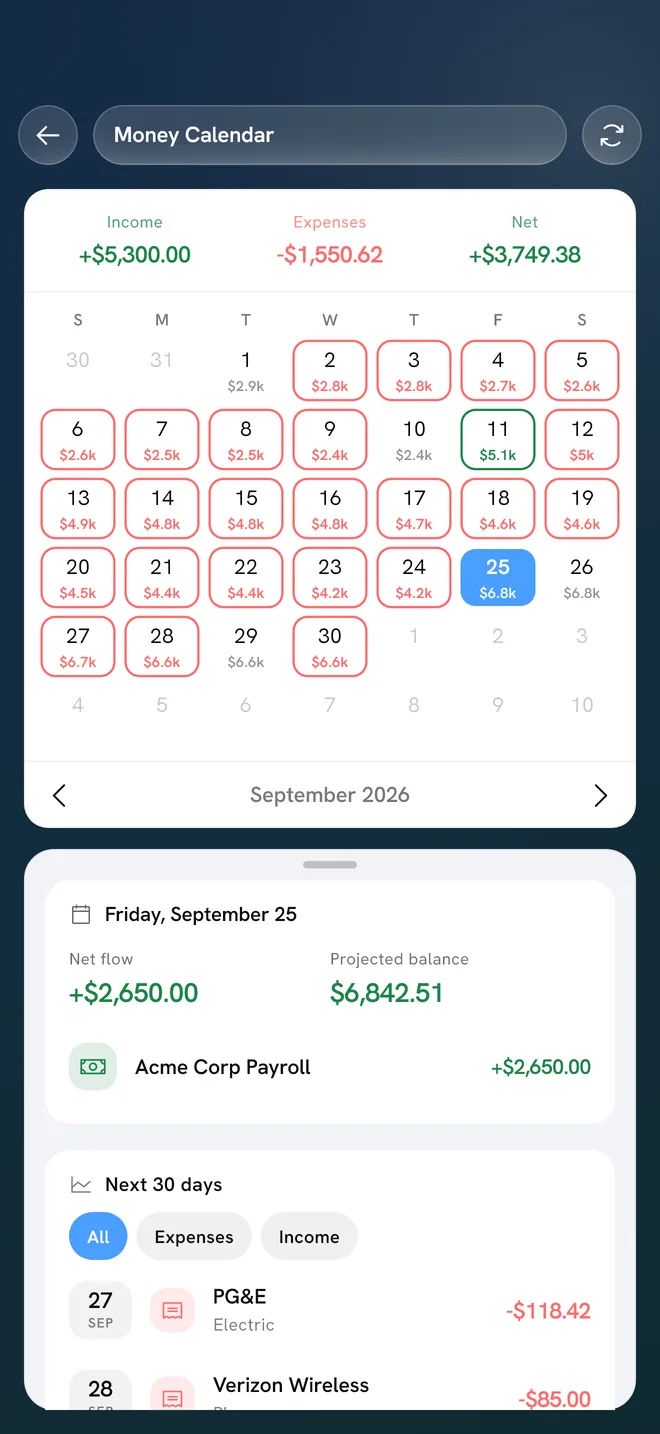
In Aurelo: The Money Calendar puts your month on a calendar, with income, bills and a projected balance for each day, plus a list of the next 30 days. A dip on a particular day is visible before you get there, while there’s still time to move something. It’s free on every plan.
Step 4: Know what’s really safe to spend
A healthy-looking balance can hide bills that haven’t come out yet. Before a larger purchase, ask: after the bills due before payday, how much is actually free?
That’s a simple subtraction: balance, minus bills before payday, minus anything you’ve already planned for. If the answer is small or negative, the purchase can usually wait a few days.
In Aurelo: Today’s Allowance does this subtraction for you: your checking balance, minus the bills due before your next payday, minus what your pockets still need. If it turns negative it goes red and offers a Reshuffle, so you can move money between pockets before a bill bounces.
Step 5: Tame the recurring charges
Automatic payments are the most common source of surprise overdrafts, because nobody is watching when they go out.
- Make a list of every recurring charge, with its date and usual amount. Finding every subscription walks through how.
- Check card autopay settings. Paying the full statement balance is great for avoiding interest, but make sure checking can cover it. Budgeting with credit cards explains how to set that money aside as you spend.
- Watch for yearly charges. An annual renewal can be several times a monthly bill. Sinking funds help you have that money ready.
In Aurelo: Aurelo detects recurring bills from your transactions and shows what’s due and when. It only shows a bill it’s confident about, so the list you see is one you can plan around.
If you already got hit
- Ask for a refund. Call or message the bank and ask them to waive the fee, especially if it’s the first in a while. Many will.
- Bring the balance back above zero quickly. Some banks charge extra if the account stays negative.
- Look at what caused it. A timing clash, a forgotten renewal, a bigger-than-usual autopay? Fix that specific cause so it doesn’t repeat.
- File a complaint if something looks wrong. If you were charged a debit overdraft fee without having opted in, the CFPB accepts complaints.
The short version
- Check whether you’re opted in to debit and ATM overdraft coverage, and decide on purpose.
- Remember checks and automatic payments can still overdraw you.
- Keep a small buffer in checking that you never spend.
- Look at the bills due before payday, not just today’s balance.
- List every recurring charge and line due dates up with paydays.
Common questions
How do I stop overdraft fees on my debit card?
Tell your bank you do not want overdraft coverage for ATM and one-time debit card transactions. Without that opt-in, those transactions are generally declined instead of paid with a fee. Confirm the change in writing or in the app.
Can a bank charge an overdraft fee if I didn't opt in?
For ATM withdrawals and one-time debit card purchases, generally no. For checks and recurring electronic payments, such as automatic bill payments, banks can still charge overdraft or non-sufficient funds fees even if you didn't opt in.
Can I get an overdraft fee refunded?
Often it's worth asking. Many banks will waive a fee as a courtesy, especially if it's rare on your account. If you think a fee was charged improperly, you can also file a complaint with the CFPB.
Is there a limit on overdraft fees?
There is no general federal cap. A 2024 CFPB rule would have limited fees at very large banks, but Congress overturned it in 2025. Your bank's fee schedule sets the amount and any daily limit, so check it.
Sources
- Overdraft/NSF Revenue in 2023 down more than 50% versus pre-pandemic levels , Consumer Financial Protection Bureau, 2024
- Economic Well-Being of U.S. Households in 2025: Banking , Federal Reserve Board, 2026
- What can I do if my bank charged me a fee for overdrawing my account? , Consumer Financial Protection Bureau, 2024
- Congress Repeals CFPB's Overdraft Rule , Congressional Research Service, 2025
Written by the Aurelo team. We build Aurelo, a budgeting app that reads your accounts read-only and never moves your money. Every claim about the app is checked against the app itself, and every figure links to its source. This is general education, not financial, tax or legal advice.