Key takeaways
- Paid every two weeks, you get 26 paychecks a year, not 24, so two months each year bring a third check.
- Assign each bill to the specific paycheck that pays it, based on due dates, not on the month.
- Build your monthly plan on two paychecks and treat the third as money with a job you chose in advance.
- Moving a due date or two is often the fastest fix for a paycheck that is always stretched.
Most budgeting advice assumes you are paid once a month. Many people are not. In February 2023, the Bureau of Labor Statistics estimated that 43 percent of U.S. private establishments paid their employees every two weeks, making biweekly the most common pay schedule in the country.1
Biweekly pay has a rhythm that a monthly budget does not quite match. Rent is due on the 1st, but your paychecks land on Fridays that drift through the calendar. Some months one check has to carry almost everything. And twice a year, a third paycheck shows up. This guide shows how to line those up so each check knows its job.
The 26-paycheck year
A year has 52 weeks. Paid every other week, that is 26 paychecks. Twelve months with two paychecks each would only be 24. The two left over fall in months that happen to contain three paydays.
Example: Your first payday of the year is Friday, January 9. Counting forward every 14 days, you are paid on January 9 and 23, February 6 and 20, and so on. Two months in that year will contain three Fridays that fall on your schedule. Your pay calendar or payroll portal will show you exactly which ones.
That creates two practical facts:
- Most months, you have two paychecks. Plan your normal life on that.
- Two months a year, you have three. That third check is money your monthly bills do not need, as long as your plan was built on two.
If you have been budgeting by taking your yearly salary and dividing by 12, you have been planning on about 2.17 paychecks a month. That works on paper, but in real months you only ever have two or three, never 2.17. Budgeting on two is steadier.
Step 1: Find your real take-home per paycheck
Start with what actually lands in your checking account, after taxes, insurance, and retirement contributions. Look at your last two or three deposits. If they vary because of overtime or tips, use the lowest recent amount as your planning number and treat anything above it as a bonus.
Example: Your take-home is $1,900 every two weeks. Your planning income is $3,800 a month, from two checks.
Step 2: List every bill with its due date
Write down each fixed bill and the date it is due. Rent, utilities, phone, insurance, a car payment, a loan, card payments, subscriptions. The due date matters more than the amount here, because it decides which paycheck has to cover it.
Step 3: Map each bill to a paycheck
Now assign each bill to the paycheck that arrives before its due date. A simple approach: the first paycheck of the month covers bills due from roughly the 1st to the 14th, and the second covers the 15th to month end. Adjust to your actual paydays.
| Bill | Due | Amount | Paid from |
|---|---|---|---|
| Rent | 1st | $1,350 | Second check of the previous month |
| Car payment | 8th | $310 | First check |
| Phone | 12th | $70 | First check |
| Car insurance | 18th | $140 | Second check |
| Electric and internet | 22nd | $160 | Second check |
| Streaming and apps | various | $45 | Split |
Example numbers only.
Look at the totals. In this example, rent alone is $1,350 of a $1,900 check. If rent is paid from the second check of the previous month, that check is carrying most of the weight while the other has room. Knowing that ahead of time is the whole point. You can set aside part of the lighter check for the heavy one, or change when bills are due.
The cost of getting this wrong is real. When a bill arrives a few days before the paycheck meant to cover it, it can overdraw an account. In 2023, the banks that report these figures collected $5.83 billion in overdraft and insufficient-funds fees.2 A timing plan is one of the simplest ways to keep your share of that at zero.
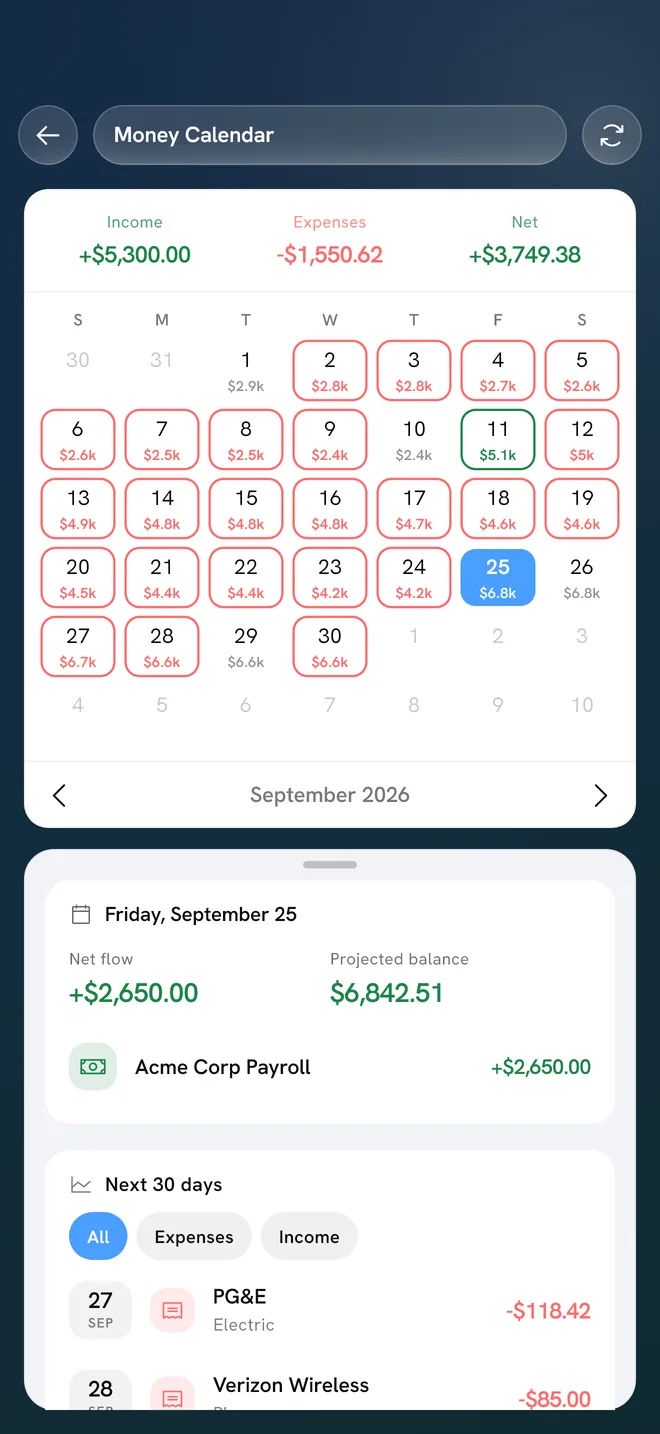
In Aurelo: The Money Calendar puts your month on a calendar: income, bills, and a projected balance for each day, plus a list of the next 30 days. It makes it easy to spot the week where a bill lands before your paycheck does.
Step 4: Give the rest of each paycheck a plan
After bills, split what is left in each check across everyday needs and wants. Groceries, gas, household basics, eating out, fun. It helps to split these evenly between the two checks, since you spend on them every week.
Example: From each $1,900 check, bills use about $1,000 on average. The remaining $900 per check might go to $300 for groceries, $120 for gas, $80 for household and personal items, $150 for eating out and fun, $100 for yearly bills, and $150 for savings.
If you want a structure for these amounts, the 50/30/20 rule is a quick starting point, and zero-based budgeting is a good fit when you want every dollar of each check planned.
Step 5: Move due dates if you can
If one paycheck is always overloaded, the fastest fix is often a phone call. Many lenders, card issuers, and utilities let you choose or change a due date. Moving one large bill from the first half of the month to the second can balance the two checks without changing a single amount.
What to do with the extra paychecks
Here is where biweekly pay quietly helps. If your plan runs on two checks a month, the two extra checks each year are unassigned money. Decide what they are for before they arrive, or they tend to blend into ordinary spending.
Good jobs for a third paycheck:
- Build an emergency buffer. In the Federal Reserve’s survey for 2025, 63 percent of adults said they would cover a $400 emergency expense with cash or its equivalent.3 One extra check can move you from the other group into that one. See how big an emergency fund should be.
- Fund yearly bills ahead of time. Car registration, insurance premiums, and memberships are easier when the money is already waiting. Sinking funds turn those into small monthly amounts, and an extra check can fill them in one go.
- Pay down a high-interest balance. A card balance costs money every month it sits there. A lump sum from an extra check makes a visible dent.
- Get a paycheck ahead. Hold the third check in checking and let it cover next month’s early bills. Over time, you move from paying this month’s bills with this month’s pay to paying them with last month’s, which takes a lot of pressure out of timing.
You can also split it: half to savings, half to something you have been putting off. The key is that the decision is made in advance, not the day the money arrives.
In Aurelo: When your paycheck lands, Smart Fill proposes how much to put in each pocket through your next payday, covering the bills due before then first. You approve or change it. On a three-paycheck month, whatever is left after your plan is simply money you can assign on purpose.
Common mistakes with a biweekly budget
- Budgeting on the annual average. Dividing yearly pay by 12 overstates what you have in 10 months out of 12. Plan on two checks.
- Ignoring which check pays which bill. A month can balance on paper and still overdraw on the 3rd.
- Spending the extra paycheck by accident. If it has no job, it will find one.
- Forgetting that paydays drift. Your paydays land on different dates each month. Check the calendar when a month starts rather than assuming last month’s pattern.
A simple weekly routine
Once a week, or on each payday, take ten minutes:
- Check what is due before your next paycheck.
- Confirm your balance covers it, with room for groceries and gas.
- Assign the new paycheck: bills first, then needs, then wants and savings.
If money is tight right now, living paycheck to paycheck walks through the three numbers that matter most between paydays.
How Aurelo fits a biweekly schedule
Aurelo builds your budget from your real transactions and groups it into pockets for Bills, Needs, and Wants. It detects recurring bills and shows what is due and when, so mapping bills to paychecks does not have to happen on a spreadsheet. Today’s Allowance shows what you can spend today after the bills due before your next payday and what your pockets still need. When a third paycheck arrives, the Save tab shows what you can save this month; you move it yourself in your bank and tap Log it so Aurelo keeps track.
Common questions
How many 3-paycheck months are there in a year?
If you are paid every two weeks, usually two. Fifty-two weeks divided by two gives 26 paychecks, which is two more than two per month. Which months get the extra check depends on your first payday of the year, so check your pay calendar.
Should I budget monthly or per paycheck when I'm paid biweekly?
Both, in layers. Plan the month so you know the total, then split it by paycheck so you know which check covers which bills. The per-paycheck view is what keeps a bill from landing before the money that pays it.
What should I do with the extra biweekly paycheck?
Decide before it arrives. Common choices are building an emergency buffer, paying down a high-interest balance, funding yearly bills ahead of time, or getting one paycheck ahead so next month starts calmer. Any of these beats letting it disappear into everyday spending.
Is biweekly the same as semimonthly pay?
No. Biweekly means every other week, on the same weekday, for 26 checks a year. Semimonthly means twice a month on set dates, such as the 1st and 15th, for 24 checks a year. Semimonthly checks are slightly larger, and there are no extra paycheck months.
Sources
- Length of pay periods in the Current Employment Statistics survey , U.S. Bureau of Labor Statistics, 2023
- Overdraft/NSF Revenue in 2023 down more than 50% versus pre-pandemic levels, saving consumers over $6 billion annually , Consumer Financial Protection Bureau, 2024
- Economic Well-Being of U.S. Households in 2025: Savings and Investments , Federal Reserve Board, 2026
Written by the Aurelo team. We build Aurelo, a budgeting app that reads your accounts read-only and never moves your money. Every claim about the app is checked against the app itself, and every figure links to its source. This is general education, not financial, tax or legal advice.