
Key takeaways
- Overspending is usually a visibility and timing problem, not a willpower problem.
- Check one number before you buy: what is safe to spend today after bills and planned spending.
- Add friction where you overspend and remove it where you save.
- Plan for wants on purpose; a budget with no fun in it is the one that breaks.
If you keep ending the month with less than you expected, you are in good company. In the Federal Reserve’s survey for 2025, only 41 percent of adults said they always or often had money left over at the end of the month.1 For most people, the month runs out before the paycheck does, at least some of the time.
The usual advice is to try harder: skip the coffee, stop shopping, be more disciplined. That rarely lasts, because overspending is usually not about discipline. It is about not seeing the right number at the right moment, and about a plan that leaves no room for the things you actually want. Fix those two things and the willpower part gets much smaller.
Why overspending happens
A few patterns cause most overspending:
- The balance looks bigger than it is. Your checking account shows $1,400. It does not show that $900 of it is rent in six days.
- Small purchases add up out of sight. A $15 lunch never feels like a problem. Fifteen of them in a month are $225.
- Cards delay the feeling. Paying later separates the purchase from the cost, so it registers less.
- The plan has no room for fun. A strict budget with nothing for wants tends to hold for two weeks, then break all at once.
- Stress and fatigue. Spending is a quick way to feel better after a hard day. That is normal, and it helps to plan for it rather than fight it.
None of these are moral failures. They are design problems, and design problems have design fixes.
Fix 1: Check one number before you buy
Your bank balance answers the wrong question. It tells you what you have, not what you can spend. The number that matters is closer to this:
Checking balance − bills due before your next payday − what your categories still need = safe to spend today
Example: You have $1,400 in checking and get paid in ten days. Before then, rent is $900 and the phone bill is $60. You still need about $220 for groceries and gas. That leaves $220 that is actually free, or about $22 a day. A $180 jacket is not impossible, but now you know it would take most of what is free until payday.
That one calculation changes the conversation you have with yourself at checkout. It turns “Can I afford this?” from a guess into a fact.
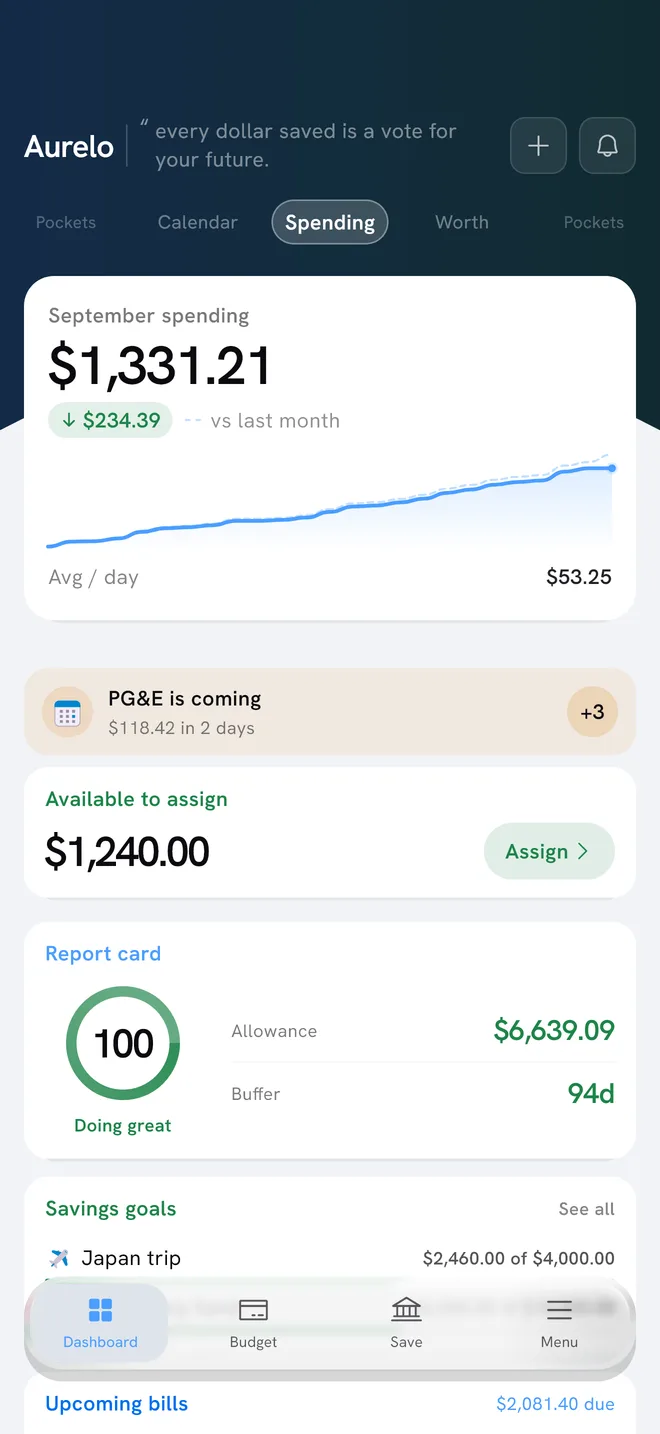
In Aurelo: Today’s Allowance is this number, worked out for you: your checking balance, minus the bills due before your next payday, minus what your pockets still need. If it goes negative, it turns red and offers a Reshuffle so you can cover the gap from another pocket.
Fix 2: Add friction where you overspend
Friction is anything that adds a step between wanting and buying. Online shopping is designed to remove it. You can add some back.
- Remove saved cards from shopping sites and apps. Typing a card number takes thirty seconds, which is often enough to reconsider.
- Log out of shopping apps, or move them off your home screen.
- Unsubscribe from sale and promotional emails. A sale you never hear about costs nothing.
- Use a waiting rule. For anything unplanned over a set amount, such as $50, wait 24 hours. For larger items, wait a week. If you still want it, buy it, from your wants money.
- Shop with a list for groceries and household items, and eat before you go.
Friction works in the other direction too: remove it where you want to save. Setting up a transfer to savings on payday, in your own bank, makes saving the default instead of a decision.
For more on why the urge to buy shows up and how to handle it in the moment, see impulse spending.
Fix 3: Make a real plan for wants
This one feels backward, but it is often what makes the rest work. Give yourself a specific amount for wants each month, and spend it without guilt.
- Name it. Dining out, hobbies, shopping, fun money. Even a small amount helps.
- Make it weekly if monthly is too long. $240 a month becomes $60 a week, which is easier to feel.
- Give each person their own fun money if you share finances. It removes a lot of small arguments. How to budget as a couple covers this.
When wants have a place in the plan, you stop having to choose between being “good” and having a life. You are simply spending what you already decided to spend.
Fix 4: Handle credit cards like cash
Cards are not the problem, but they make overspending easier to miss. The fix is to treat every card purchase as money leaving your budget the moment you tap.
Example: You spend $85 on groceries with a card. In your budget, that $85 comes out of groceries right away and is set aside for the card payment. When the bill arrives, the money is already waiting.
If you pay for most things with cards, budgeting with credit cards goes through this step by step.
In Aurelo: Card Cover handles this. When you buy something on a credit card, the money comes out of the right pocket and is set aside to pay that card, so the payment is covered when it is due. Paying the card is shown as a transfer, not new spending, so nothing is counted twice.
Fix 5: Build a cushion so one bad week is not a crisis
Overspending hurts most when there is no margin. A surprise $200 purchase becomes an overdraft or a card balance that lingers for months. In 2023, the banks that report these figures collected $5.83 billion in overdraft and insufficient-funds fees.3
A small buffer changes that. In the Federal Reserve’s survey for 2025, 63 percent of adults said they would cover a $400 emergency expense using cash or its equivalent, while 12 percent said they could not pay it by any means.2 Even a few hundred dollars set aside means a bad week stays a bad week. Start with a target you can reach in a few months; how big your emergency fund should be helps you choose one.
What to do when you have already overspent
It will happen. The question is what comes next.
- Do not abandon the month. Overspending in one category does not mean the budget failed.
- Cover it from somewhere else. Move money from a category with room left, such as dining out or shopping, to the one that ran over.
- Note why. Was it a one-off, or does this category keep running over?
- Adjust if it repeats. If groceries are over three months in a row, the plan was probably too low. Raise it and take the difference from somewhere realistic.
A budget that bends is much more useful than one that snaps. Why budgets fail explains more about building one that lasts.
A simple plan to start this week
- Work out what is safe to spend today, and check it before any unplanned purchase.
- Remove saved cards from your two most-used shopping sites.
- Set a 24-hour rule for unplanned buys over $50.
- Put a specific amount for wants in your budget.
- Check your spending once a week for ten minutes.
None of it requires more discipline. It just puts the right information and a little space in front of each decision.
Common questions
Why do I keep overspending even with a budget?
Usually because the budget is not in front of you at the moment you spend. Your bank balance looks fine, so the purchase feels fine, even when bills are coming. A daily safe-to-spend number and a quick weekly check close that gap.
What is a good way to stop impulse purchases?
Add a pause. Wait a day for anything unplanned over a set amount, remove saved cards from shopping sites, and unsubscribe from sale emails. Most urges fade with a little time and effort between you and the checkout button.
How do I stop overspending on a credit card?
Treat each card purchase as money leaving your budget right away, from the same category it would if you paid with debit. Then set that amount aside for the card payment. The card balance should never be a surprise.
What should I do if I already overspent this month?
Cover it from another category rather than ignoring it or giving up on the month. Move money from something with room left, note what caused it, and adjust next month's number if it keeps happening.
Sources
- Economic Well-Being of U.S. Households in 2025: Income and Expenses , Federal Reserve Board, 2026
- Economic Well-Being of U.S. Households in 2025: Savings and Investments , Federal Reserve Board, 2026
- Overdraft/NSF Revenue in 2023 down more than 50% versus pre-pandemic levels, saving consumers over $6 billion annually , Consumer Financial Protection Bureau, 2024
Written by the Aurelo team. We build Aurelo, a budgeting app that reads your accounts read-only and never moves your money. Every claim about the app is checked against the app itself, and every figure links to its source. This is general education, not financial, tax or legal advice.