
Key takeaways
- Impulse spending is a normal response to emotion, design and easy payment, not a personal failing.
- Countdown timers, fake scarcity and split payments are built to shorten the time you spend deciding.
- A pause, a clear daily number and a planned amount for wants curb most impulse buys.
- Buy now, pay later spreads the cost but not the budget impact; count the full price when you buy.
You open an app to check one thing and ten minutes later you have bought a lamp. You walk into a store for milk and leave with snacks, a candle and a phone charger. Impulse spending happens to almost everyone, and it is not a sign that you are bad with money. It is what happens when a normal human reaction meets a shopping experience designed to make buying fast.
This guide explains why impulse buys happen, the tactics that encourage them, and a few changes that make a real difference without turning your life into a list of rules.
What impulse spending actually is
An impulse purchase is one you did not plan and decided on in the moment. That alone is not a problem. A spontaneous coffee with a friend, from money you set aside for fun, is a perfectly good use of money.
It becomes a problem when:
- The money comes from something already spoken for, such as rent, groceries or savings.
- It happens often enough that you lose track of the total.
- You regret it soon after, or hide it from yourself or a partner.
The goal is not to eliminate spontaneity. It is to make sure impulse buys come from the right money.
Why it happens
Emotion
Buying something gives a small lift. After a stressful day, a boring afternoon, or a moment of feeling behind, that lift is appealing. Many people notice they shop more when tired, anxious, or lonely. That is normal, and knowing your own triggers is more useful than trying to ignore them.
Speed
The less time between wanting and buying, the more likely you are to buy. Saved cards, one-tap checkout, and phones that are always within reach have shortened that time to a few seconds.
Design built to rush you
Some shopping sites and apps are designed specifically to cut your thinking time short. The Federal Trade Commission calls these “dark patterns.” In a 2022 report, it described countdown timers meant to make shoppers believe an offer is time-limited when it is not, and prices advertised without mandatory fees that only appear late in checkout.1
Other common tactics include “only 2 left” messages, notifications about what other people just bought, and free shipping thresholds that nudge you to add one more item. Once you recognize them, they lose a lot of their pull.
Payments that feel smaller than they are
Splitting a purchase into installments makes the first payment feel light. In the Federal Reserve’s survey for 2025, 16 percent of adults said they had used buy now, pay later in the prior 12 months, and slightly more than a quarter of those users had been late on a payment.2 Nearly half of users said they had used it for clothing and accessories at least once.2
Installments can also stack up. In research published in 2025, the Consumer Financial Protection Bureau found that about 63 percent of buy now, pay later borrowers had taken out several loans at the same time at some point during the year.3 Each one looks small. Together they can take a real bite out of future paychecks.
How to curb impulse spending
1. Put a pause between wanting and buying
A pause is the single most effective tool, because most urges fade.
- The 24-hour rule. For anything unplanned over a set amount, such as $40, wait a day. If you still want it tomorrow, you can buy it.
- Leave it in the cart. Online, add it to your cart and close the tab. Come back later. Often you will not.
- Remove saved cards from shopping sites and apps, so each purchase takes a minute of typing.
- Move shopping apps off your home screen, or delete the ones you use most when bored.
2. Know what you can actually spend today
Impulse buys are easier to say yes to when your bank balance looks healthy. But a balance does not show the bills coming before payday. Before any unplanned purchase, check what is left after those bills and your planned spending. If the number is small, the decision often makes itself.
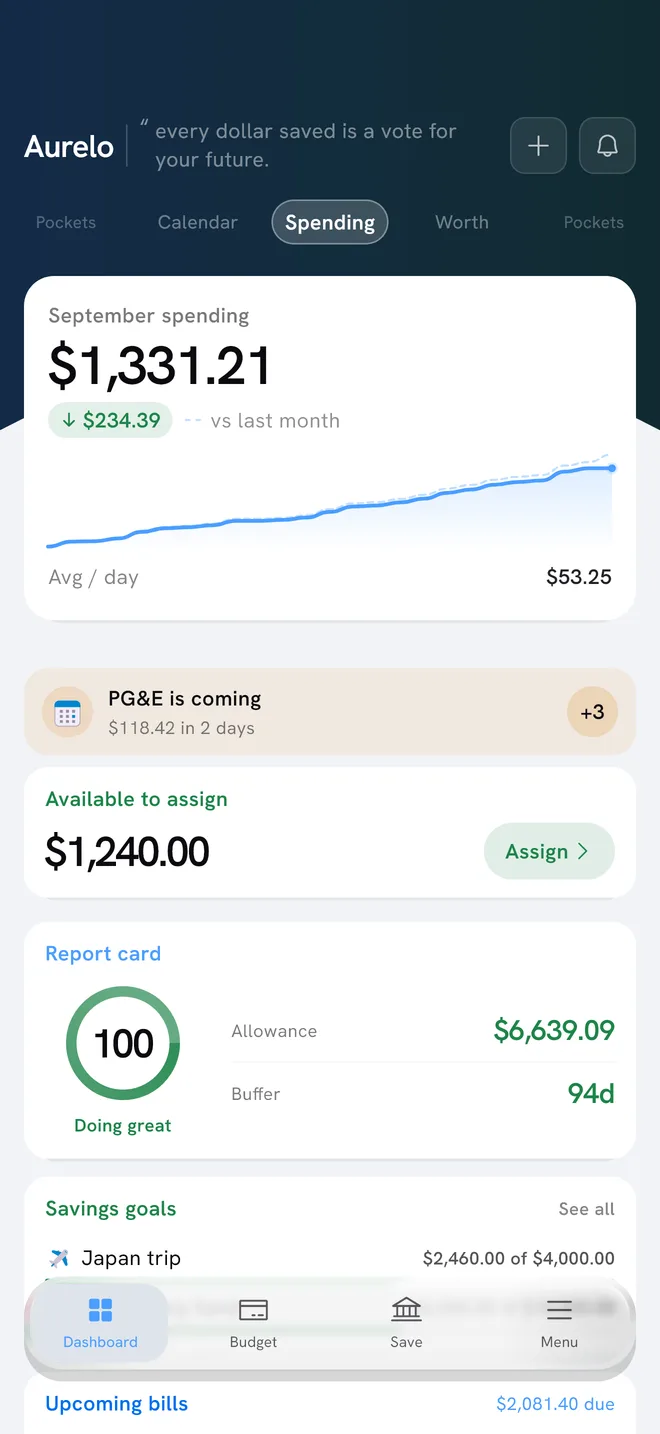
In Aurelo: Today’s Allowance shows what you can spend today: your checking balance, minus the bills due before your next payday, minus what your pockets still need. It is a quick check before a purchase you did not plan.
3. Plan for spontaneity
This sounds like a contradiction, but it works. Set aside a monthly amount for unplanned wants, sometimes called fun money. When something catches your eye, it comes from there. If the fun money is gone for the month, the answer is “next month,” not “never.”
Example: You set aside $120 a month for unplanned wants. A $35 book and a $50 pair of shoes both fit. A $300 speaker does not, this month, but you could save toward it over three months.
This removes the guilt from spontaneous purchases that fit, and gives you a clear, friendly no for the ones that do not.
4. Count installments at their full price
If you use buy now, pay later, treat the purchase as its full price the day you buy it. Take the full amount out of the right category in your budget and set aside the future payments. That keeps a $200 purchase from feeling like $50, and it prevents several small plans from quietly adding up.
5. Reduce the invitations
Many impulse buys start with a prompt you did not ask for.
- Unsubscribe from promotional emails and turn off shopping app notifications.
- Unfollow accounts that mostly exist to sell you things.
- Shop from a list for groceries and household items.
- Avoid browsing stores, online or in person, as a way to pass time.
6. Notice your triggers
For a couple of weeks, when you make an unplanned purchase, note how you were feeling and what you were doing. Patterns show up fast: late at night, after a hard call, on payday. Once you know yours, you can plan a different response, like a walk, a message to a friend, or simply the 24-hour rule.
What to do after an impulse buy you regret
- Check the return policy. Many purchases can go back, and a quick return is not a failure.
- Cover it in your budget. Move money from another category with room, so the rest of the month still works.
- Skip the guilt spiral. One purchase does not define your finances. Note the trigger and move on.
If impulse buys keep pushing you over, how to stop overspending covers the bigger picture, and how to track your spending helps you see the total over a month.
In Aurelo: If a pocket runs over, Reshuffle lets you move money from another pocket to cover it. Your Wants pockets hold what you have planned for fun, so you can see at a glance how much room is left before you buy.
The short version
Impulse spending is a mix of feelings, speed and design. You do not need to fight all three with willpower. Slow the process down, check what you can really spend today, give spontaneity its own planned amount, and count installments at full price. If you have not set up a budget yet, how to make a budget is a good place to start.
Common questions
What causes impulse spending?
Usually a mix of emotion and opportunity: stress, boredom or a reward feeling, combined with shopping that takes one tap. Sales pressure and saved payment details make the gap between wanting and buying very short.
How do I stop impulse buying online?
Remove saved cards, log out of shopping apps, unsubscribe from promotional emails, and leave items in your cart for a day before deciding. Most online impulse buys depend on speed; slowing the process down takes away much of the pull.
Is impulse spending always bad?
No. A spontaneous purchase you can afford, from money set aside for wants, is fine. It becomes a problem when it comes out of money meant for bills or savings, or when it happens often enough that you lose track.
Does buy now, pay later count as impulse spending?
It can make impulse spending easier, because a smaller first payment feels lighter than the full price. The purchase still costs the full amount, and the later payments are already committed from future paychecks.
Sources
- FTC Report Shows Rise in Sophisticated Dark Patterns Designed to Trick and Trap Consumers , Federal Trade Commission, 2022
- Economic Well-Being of U.S. Households in 2025: Credit , Federal Reserve Board, 2026
- CFPB Research Reveals Heavy Buy Now, Pay Later Use Among Borrowers with High Credit Balances and Multiple Pay-in-Four Loans , Consumer Financial Protection Bureau, 2025
Written by the Aurelo team. We build Aurelo, a budgeting app that reads your accounts read-only and never moves your money. Every claim about the app is checked against the app itself, and every figure links to its source. This is general education, not financial, tax or legal advice.