
Key takeaways
- Pick one tracking method you will actually keep: a bank-connected app, a manual log, or a monthly statement review.
- A short weekly check-in beats a long monthly one; ten minutes is enough.
- Look for patterns, not individual purchases: totals by category, frequency, and what changed from last month.
- Tracking works best when it answers one question: is my spending matching my plan?
Tracking your spending sounds simple until you try it. You save receipts for four days, forget on the fifth, and by the end of the month you have a pile of paper and a vague sense of guilt. That is not a character flaw. Most tracking systems ask for too much effort, too often, for too little payoff.
The good news is that tracking does not need to be detailed to be useful. It needs to be consistent, and it needs to answer one question: is my money going where I meant it to? Here is how to set that up so it takes minutes a week.
Why tracking matters, even if you have a budget
A budget is a plan. Tracking is how you find out whether the plan is happening. Without it, a budget is a wish list.
It also catches drift. Spending tends to rise quietly, a little at a time. In the Federal Reserve’s survey for 2025, 35 percent of adults said their monthly spending had gone up over the prior year, slightly more than the 32 percent who said their income had.1 When spending grows faster than pay, the gap usually shows up first in tracking, long before it shows up as a credit card balance.
And tracking is what gives you money left over on purpose. In the same survey, 41 percent of adults said they always or often had money left at the end of the month.1 Knowing where your money goes is the first step toward being in that group more often.
Three ways to track spending
There are three main methods. Each works; they differ in how much effort they take and how current they are.
1. A bank-connected app
An app connects to your checking account and cards, pulls in your transactions, and sorts them into categories. You review and fix anything it got wrong.
- Best for: people who pay mostly by card, and anyone who knows they will not type things in.
- Effort: low. A few minutes a week to review.
- Watch for: sorting mistakes. Check the categories now and then, especially for stores that sell many kinds of things.
If you are unsure about connecting your bank, is it safe to connect your bank covers how read-only connections work.
2. A manual log
You write down each purchase as it happens, in a notes app, a spreadsheet, or a small notebook. Date, amount, what it was.
- Best for: people who use cash often, or who want to feel every purchase. Writing it down makes you notice.
- Effort: higher. It takes a few seconds each time, and it only works if you do it the same day.
- Watch for: gaps. One forgotten day turns into a forgotten week. Pair it with a quick statement check at the end of each week to catch what you missed.
3. A statement review
Once a month, you download or open your bank and card statements and sort the transactions into categories, often with a spreadsheet.
- Best for: people who want a clear monthly picture and do not mind a longer session.
- Effort: about an hour a month, once you have a template.
- Watch for: lateness. By the time you see a problem, the month is over. Adding a short midmonth look helps.
Many people end up combining methods: an app for card spending, a quick manual note for cash, and a monthly look at the bigger picture.
In Aurelo: Connect your checking account and credit cards through Plaid (read-only), and Aurelo reads your transactions and sorts them into pockets. If you move a merchant to a different pocket consistently, Aurelo asks “Remember this?” and files it the same way next time. You can also skip the bank and log spending by hand.
How often to check in
The most useful rhythm for most people:
- Once or twice a week, for ten minutes. Look at what came in since last time. Fix any miscategorized items. Glance at which categories are close to their limit.
- At the end of each month, for thirty minutes. Compare totals to your plan. Note what surprised you. Adjust next month’s numbers.
Weekly matters most. A category that is 80 percent spent by the 10th is a problem you can still solve. The same category discovered on the 30th is just a story about what happened.
Pick a fixed time, such as Sunday morning or payday, so it becomes routine rather than a decision.
What to look for (and what to ignore)
Tracking produces a lot of data. The skill is knowing which parts matter.
Look at:
- Totals by category. Where did most of the money go? Is that where you expected?
- Frequency. Ten $12 lunches matter more than one $60 dinner. Small, frequent purchases are where spending hides. Food away from home is a common example: the average U.S. household spent $3,945 on it in 2024, according to the Bureau of Labor Statistics.2
- Change from last month. A category that jumped deserves a look. One that is steady probably does not.
- Recurring charges. Subscriptions and memberships that renew automatically. Finding every subscription walks through spotting them.
- Fees. Overdraft fees, late fees, foreign transaction fees, ATM fees. These are often avoidable once you see them.
Mostly ignore:
- Single purchases you already decided on. You planned the concert tickets. No need to feel anything about them again.
- Small rounding differences. Being $4 over on household supplies is not a trend.
- Comparisons with other people. Your spending only needs to match your plan.
Make it easier to keep going
A few habits that keep tracking from becoming a chore:
- Use fewer categories. Twelve to twenty is plenty. See the budget categories list for a starting set.
- Keep one card for everyday spending. Fewer accounts means fewer places to check.
- Do not aim for perfect. If a transaction takes more than a few seconds to categorize, put it somewhere reasonable and move on.
- Connect tracking to a plan. Tracking without a budget shows you the past. Tracking against a budget tells you what to do next. If you do not have one yet, start with how to make a budget.
When tracking shows something you do not like
It will, at some point. A category is higher than you guessed, or a month got away from you. That is the system working. The point of tracking is to find those things while you can still adjust.
Resist the urge to overcorrect. Slashing a category to zero rarely lasts. A better move is to set a realistic number, based on what you actually spend, and bring it down gradually. If overspending is the pattern, how to stop overspending has practical fixes that do not rely on willpower.
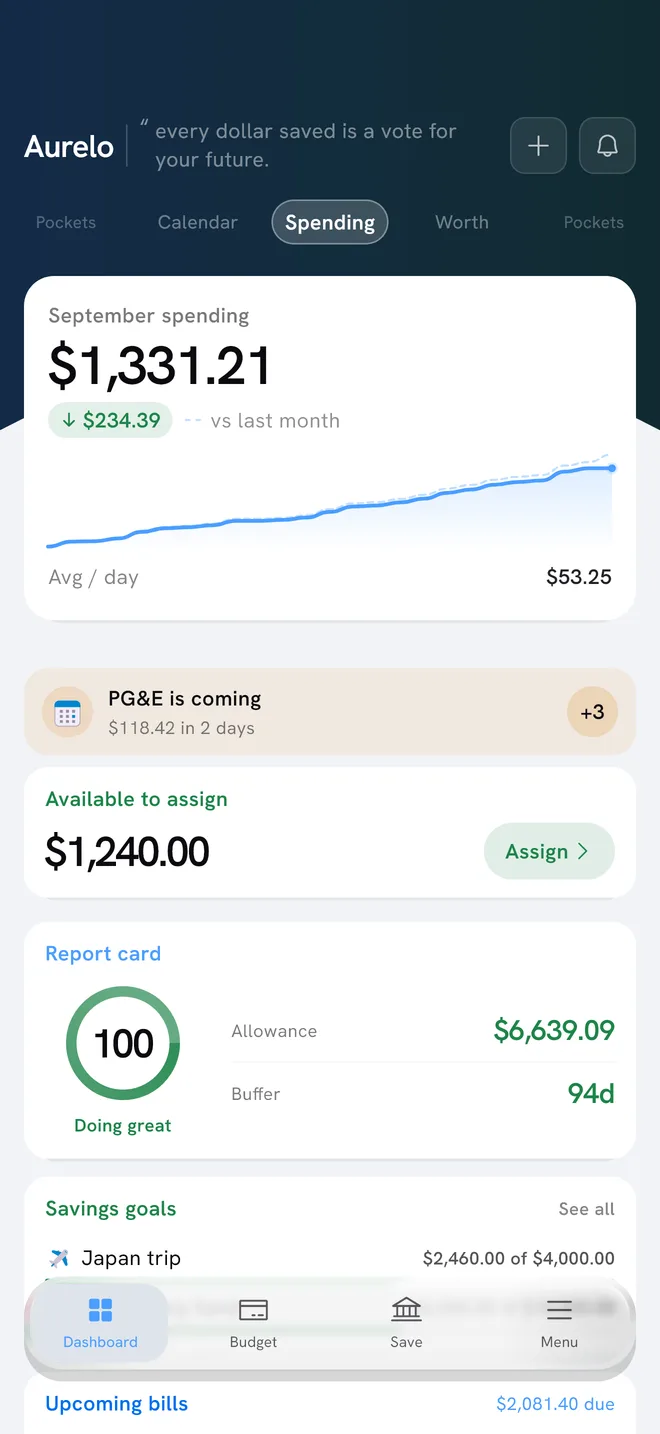
In Aurelo: The dashboard shows this month’s spending against last month, with a Report card for your Aurelo Score, Today’s Allowance and Buffer Days. Each pocket shows what is left, with refunds subtracted from spending. At the end of each month, the Monthly recap shows what came in, what went out, and how each pocket did.
A tracking routine you can start tonight
- Choose one method: app, manual log, or monthly statement review.
- Set up 12 to 20 categories.
- Put a weekly ten-minute check-in on your calendar.
- After one month, look at the totals and adjust your budget to match reality.
That is enough. Consistency matters more than detail, and a quick, honest weekly look will tell you more than a perfect spreadsheet you abandon in week two.
Common questions
What is the easiest way to track spending?
For most people, an app connected to their bank, because transactions arrive without typing. If you prefer not to connect a bank, a simple notes list or spreadsheet you update every day or two works too. The easiest method is the one you will keep doing.
How often should I track my spending?
A quick look once or twice a week, plus a slightly longer review at the end of the month. Weekly catches problems while there is still time to adjust. Monthly shows the bigger pattern.
Should I track every single purchase?
Every purchase should land somewhere, but you do not need to study each one. Once spending is sorted into categories, look at the totals and the few categories that surprised you.
How long does it take to see useful patterns?
Usually a month or two. One month shows where money went. Two or three months show what is normal for you, which is when your budget numbers become realistic.
Sources
- Economic Well-Being of U.S. Households in 2025: Income and Expenses , Federal Reserve Board, 2026
- Consumer Expenditures — 2024 , U.S. Bureau of Labor Statistics, 2025
Written by the Aurelo team. We build Aurelo, a budgeting app that reads your accounts read-only and never moves your money. Every claim about the app is checked against the app itself, and every figure links to its source. This is general education, not financial, tax or legal advice.