Key takeaways
- Plan around your leanest recent month, not your average, so slow months are already covered.
- Rank your pockets so you know exactly what gets funded first when money arrives.
- Build a buffer of at least one month of baseline expenses, then keep growing it.
- Decide in advance where a big month's extra goes, and plan to the next payday, not the calendar.
Most budgeting advice quietly assumes a steady paycheck: the same amount, on the same day, every two weeks. If you freelance, work on commission, drive for a delivery app, run a small business or pick up seasonal shifts, that assumption breaks on day one. You might earn $7,000 one month and $2,800 the next.
You are far from alone. In the Federal Reserve’s 2025 survey of household finances, 30 percent of adults said their income varied at least occasionally through the year, and 11 percent said they had struggled to pay their bills in the prior 12 months because of it.1 Among self-employed adults, 58 percent said their income varied from month to month, and 22 percent had struggled to pay bills as a result.1 Independent contracting alone accounts for a sizable group: the Bureau of Labor Statistics counted 11.9 million independent contractors in its July 2023 survey, 7.4 percent of total employment.2
Budgeting on an irregular income is not harder because you are worse with money. It is harder because the usual methods do not fit the shape of your pay. The fix is to plan around what you can count on and treat everything above it as a bonus with a job already decided.
Step 1: Find your baseline month
Your baseline is the income you plan around. It should be a number you are confident you will hit even in a slow month.
- Look at your take-home income for each of the last six to twelve months. Use what actually landed in your account, after any taxes that were withheld.
- Find the lowest month. If it was a true outlier (you were sick for three weeks, a client paid very late), use the second-lowest instead.
- That number is your baseline.
Using the average feels more generous, but it is the trap. An average of $4,500 means some months come in well under $4,500, and a plan built on the average will be short in exactly those months.
Example: Over the past six months, a freelance designer took home $5,200, $3,100, $6,800, $3,400, $4,900 and $3,300. The average is about $4,450. The lowest is $3,100. Her baseline is $3,100.
If you pay your own taxes (common for freelancers and contractors in the US), set a percentage of every payment aside for tax before it counts as income at all. Your baseline is what is left after that.
Step 2: Build the budget on the baseline, in priority order
With a baseline in hand, build a budget that fits inside it. The difference from a regular budget is that you rank your pockets, so you know exactly what gets funded first when money arrives. (The classic envelope method works the same way; Aurelo calls these pockets.)
A sensible priority order:
- Housing and utilities. Rent or mortgage, power, water, internet, phone.
- Food and transport. Groceries, gas or transit, car insurance.
- Minimum debt payments. Keep every account in good standing.
- Other fixed bills. Insurance, childcare, subscriptions you rely on.
- Buffer. Money that smooths the next thin month (more on this below).
- Sinking funds. Yearly and irregular costs, set aside monthly.
- Savings and extra debt payments.
- Wants. Eating out, hobbies, travel.
For the designer in the example, a baseline budget might look like this:
| Monthly | |
|---|---|
| Rent | $1,400 |
| Utilities, phone, internet | $220 |
| Groceries | $450 |
| Transport | $200 |
| Health insurance | $330 |
| Card minimum payment | $100 |
| Software and work tools | $80 |
| Personal and household | $150 |
| Buffer top-up | $170 |
| Total | $3,100 |
Notice what is not in the baseline budget: much in the way of wants, extra savings or annual costs. Those get funded from the months that come in above baseline. That is the whole idea: in a slow month, everything essential is covered, and nothing needs to be cut in a panic.
If you want every dollar in the baseline to have a planned purpose, zero-based budgeting pairs naturally with this approach.
Step 3: Build a buffer
The buffer is what turns an irregular income into something that feels regular. Its job is to cover the gap between a thin month and your baseline, and eventually to let you pay this month’s bills with last month’s income.
A common first target is one month of your baseline expenses. For the designer, that is $3,100 sitting aside. Once it is there, a $2,500 month is not an emergency: she spends her baseline as planned and takes $600 from the buffer. The next good month refills it.
Past that first month, many people with variable income aim for a larger cushion, often three to six months of essential expenses. This is related to, but separate from, an emergency fund for true surprises; see how big your emergency fund should be for how to think about the two.
In Aurelo: Buffer Days turns your cushion into a single number: how many days your cash in checking and savings would last at your average daily spending over the last 30 days. Under 14 days shows red, 14 to 29 yellow, 30 or more green. For a variable income, watching that number climb month over month is a clearer signal than any single paycheck.
Step 4: Know what to do in a big month and a thin month
Decide this before the month arrives. Decisions made in advance are much easier to stick to than decisions made while looking at a large deposit.
In a big month
When income comes in above baseline, send the extra down a fixed list:
- Tax set-aside, if you owe your own taxes.
- Refill the buffer to its target.
- Fund sinking funds for yearly costs (see sinking funds for annual expenses).
- Extra toward savings goals or high-interest debt.
- A planned slice for wants, so a good month still feels like one.
Example: The designer takes home $6,800. That is $3,700 above her $3,100 baseline. She puts $1,000 back into the buffer, $300 into her annual costs, $1,500 toward a savings goal, $600 toward her credit card balance and keeps $300 for a night out and a new pair of shoes.
In a thin month
When income comes in under baseline:
- Pay the top of your priority list first: housing, utilities, food, transport, minimums.
- Cover the gap from the buffer. This is what it is for.
- Pause the lower pockets (wants, extra savings) until income recovers.
- If the buffer is not enough, move money from lower-priority pockets to higher ones rather than letting a bill go late.
A thin month is not a failure. With a baseline and a buffer, it is a planned-for event.
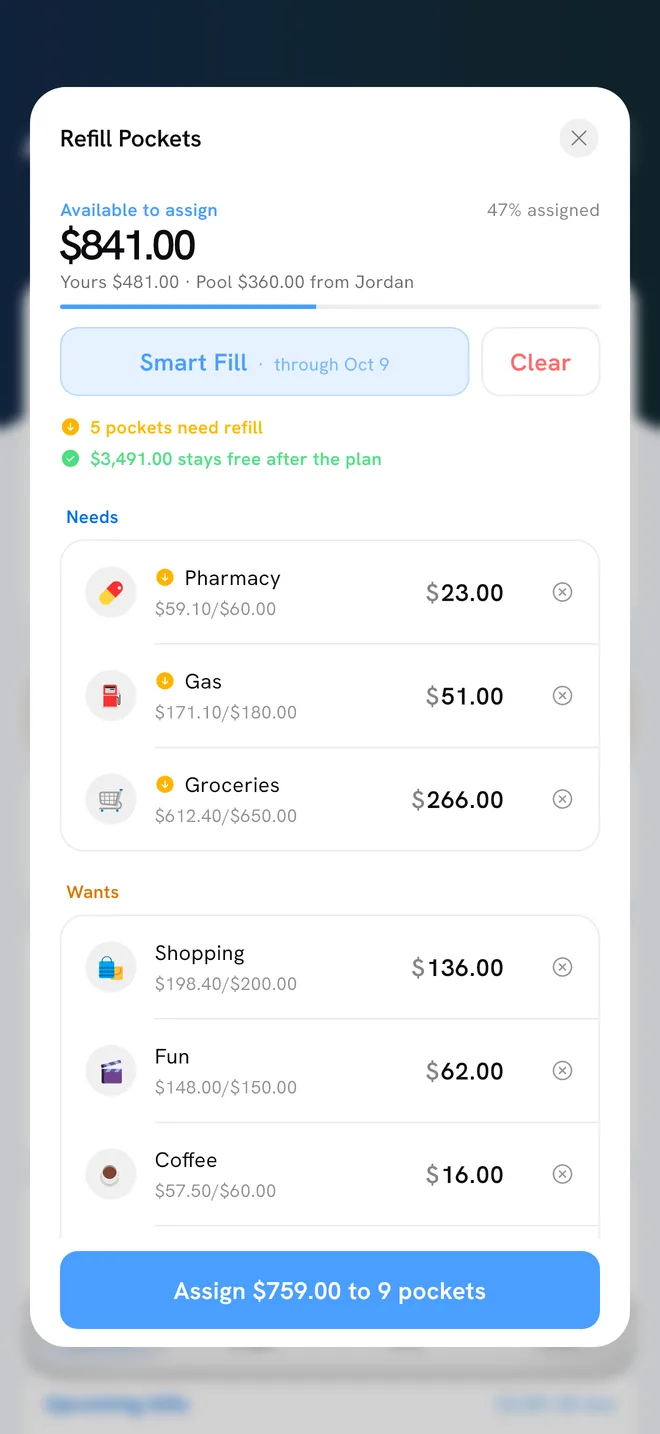
In Aurelo: When money arrives, Smart Fill proposes how to fill your pockets through your next payday, covering the bills due before then first. On a variable income that is the useful question: not “what is my monthly budget,” but “what needs to be covered until money comes in again.” You approve the plan or change it.
Step 5: Plan to the next payday, not to the calendar month
When pay is irregular, the calendar month is often the wrong unit. What matters is whether the money you have now covers everything due before the next payment lands.
A simple habit: every time money arrives, look ahead to the next expected payment and list what is due before then. Fund those first. If a large client payment is expected on the 20th, the question on the 5th is whether what you have covers rent on the 1st of next month if that payment is late. Planning against money that has not landed yet is how irregular incomes get into trouble.
It also helps to keep income and spending in separate accounts. Business or gig income lands in one account; you move your baseline to your everyday account on a set day. The income account absorbs the swings so your everyday account does not have to. It is a version of paying yourself first: the fixed transfer is your paycheck, and you decide its size in advance.
In Aurelo: The Money Calendar shows your month day by day, with income, bills and a projected balance for each day, plus a list of the next 30 days. It makes the gap between one payday and the next easy to see. The Money Calendar in Aurelo explains how to read it.
The short version
Plan around your leanest month, not your average. Fund pockets in a fixed priority order so essentials are always covered. Build a buffer of at least one month, then more. Decide in advance where a big month’s extra goes, and let the buffer carry the thin months. Irregular income will always be irregular, but a budget built this way stops it from feeling like a crisis every few weeks. For the fundamentals underneath all of this, start with how to make a budget.
Common questions
How do you budget when your income is different every month?
Build your plan around a baseline, usually your lowest recent month, not your average. Cover the essentials first, and treat anything above the baseline as extra that goes to a buffer, savings or debt in an order you decide in advance.
How much of a buffer do freelancers need?
A common starting target is one full month of essential expenses set aside, so you can pay next month's bills with money you already have. Many freelancers then work toward a larger cushion of three to six months, especially if income is seasonal.
Should I pay myself a salary from my business income?
Many self-employed people find it steadier to move a fixed amount from a separate income account to their personal account on a set schedule. The fixed amount is your baseline, and the income account absorbs the ups and downs.
What should I do with a really good month?
Resist spending it as if it will repeat. Top up the buffer first, set aside money for taxes if you owe them yourself, then put the rest toward savings or debt. A big month is best used to make the next thin month easier.
Sources
- Economic Well-Being of U.S. Households in 2025: Income and Expenses , Federal Reserve Board, 2026
- Contingent and Alternative Employment Arrangements Summary (July 2023 data) , U.S. Bureau of Labor Statistics, 2024
Written by the Aurelo team. We build Aurelo, a budgeting app that reads your accounts read-only and never moves your money. Every claim about the app is checked against the app itself, and every figure links to its source. This is general education, not financial, tax or legal advice.